16.2.7 Publish financial data
16.3 Working with government
16.3.1 Provide expert advice to government.
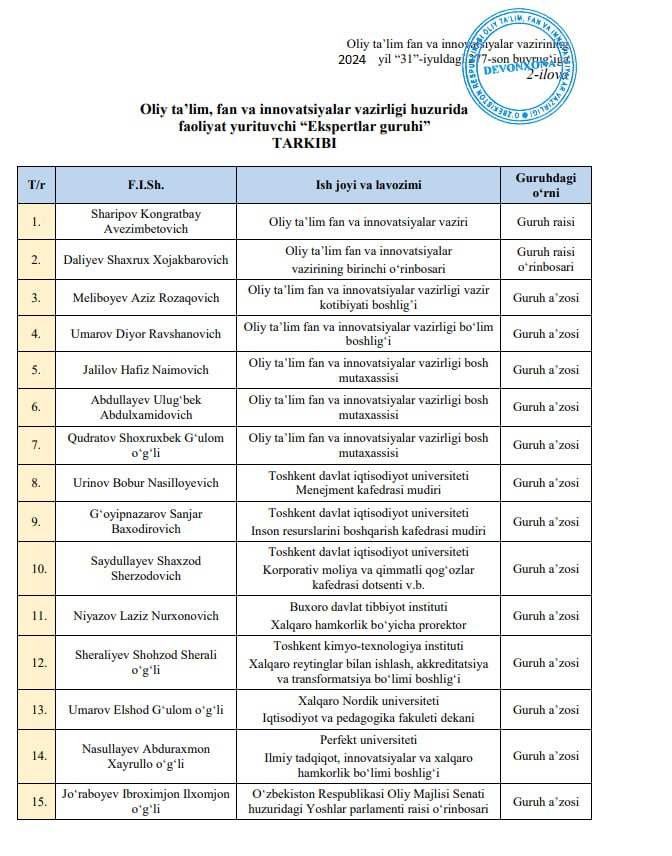
“In 2024, Vice-Rector for International Cooperation, Laziz Niyazov, served as a member of the expert group of the Ministry of Higher Education, Science and Innovation.”
16.3.2 Policy- and lawmakers outreach and education
In 2024, Bukhara State Medical Institute conducted outreach and capacity-building activities for policymakers and lawmakers.
For example:
Seminars and workshops were organized in collaboration with the Ministry of Health of Uzbekistan to train local policymakers on issues related to public health management, medical education reforms, and digitalization in healthcare.
Roundtable discussions were held with representatives of the Regional Council (Mahalliy kengash) focusing on sustainable healthcare development and social protection policies.
Educational sessions for local government representatives included topics on migration and healthcare access, climate change impacts on public health, and technological innovation in medical education.
Evidence: Seminar programs, official reports, and media coverage are available on the university’s website and are accessible to the public.
16.3.3 Participation in government research
In 2024, Bukhara State Medical Institute participated in policy-oriented research projects in collaboration with government institutions.
The university’s research teams worked jointly with the Ministry of Health of Uzbekistan on studies related to public health policy, infectious disease prevention, and digital transformation in healthcare management.
Faculty members also contributed to government-commissioned research addressing medical education reforms and regional healthcare accessibility.
Outcomes of these projects were submitted to the ministry as policy recommendations and partially published in open-access reports, ensuring transparency and public availability.
16.3.4 Neutral platform to discuss issues
Bukhara State Medical Institute provided a neutral and safe platform for dialogue among diverse stakeholders, including representatives of local government, healthcare institutions, NGOs, and civil society groups.
The university organized roundtables and public forums on issues such as public health, medical education, and sustainable development in the healthcare system.
These events created an inclusive, non-partisan environment where participants could frankly discuss challenges and propose solutions.
Outcomes of these discussions were made publicly accessible through press releases and the institute’s official website.
16.4 Proportion of graduates in law and civil enforcement
16.4.1 Indicator: Proportion of graduates in law
Year: 2024
Total number of graduates (2023): [insert total number of graduates from all programs]
Number of graduates from law and enforcement related courses (2023): 0
Since Bukhara State Medical Institute does not offer law or law-enforcement related programs, the proportion of graduates in this field is 0%.