Metrics and indicators
1.1 Research on poverty
1.1.1 Papers co-authored with low or lower-middle income countries
As part of its commitment to international scientific collaboration, Bukhara State Medical Institute (BDTI) has actively engaged in joint research with scholars from countries classified as low or lower-middle income. A notable example is the article titled “Immunometabolic Correlations of Autoantibodies in Latent Autoimmune Diabetes in Adults (LADA): A Cross-sectional Study”, co-authored by researchers from BDTI and their counterparts abroad. This study, published on ResearchGate in 2024, explores the complex interplay between immunological markers and metabolic indicators in LADA patients. It highlights the growing scientific contribution of institutions from developing countries to global biomedical research.
Read the full paper here
1.1.2. No poverty: FWCI
Scopus – Bukhara State Medical Institute.pdf
In 2024, one article on the topic of No Poverty was published in the Scopus database.
1.1.3. No poverty: publications
From 2020 to 2024 Bukhara State Medical Institute published 2540 research articles related to poverty, income inequality, and social assistance, contributing to the global efforts in achieving Sustainable Development Goal 1 (No Poverty).
Read the full paper here
Scopus – Bukhara State Medical Institute.pdf
1.2. Proportion of students receiving financial aid to attend university because of poverty
1.2. Proportion of students receiving financial aid to attend university because of poverty
2024 Data on Students Receiving Financial Support Due to Poverty One of the key barriers to accessing higher education is the lack of financial resources. Therefore, Bukhara State Medical Institute (BDTI) provides targeted financial assistance to students from low-income backgrounds, those in need of social protection, and those living under the poverty line.
Total Number of Students in 2024:
Total number of students (FTE): 9004
Bachelor’s degree: 8,248
Master’s degree: 244
Medical residency (ordinatura): 512
Number of Students Receiving Financial Support:
Total supported students: 120
Forms of Financial Support Provided:
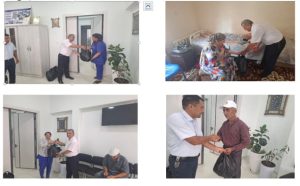
63 students received comprehensive medical check-ups and were referred for treatment.
1 student received a sewing machine worth 4,700,000 UZS.
34 students received:
9,400,000 UZS worth of clothing and food packages,
9,800,000 UZS worth of bedding sets,
2,700,000 UZS worth of household items.
6 students received electronic wheelchairs and rehabilitation aids worth 12,500,000 UZS.
9 students had medical treatment costs covered, totaling 11,000,000 UZS.
5 students had expenses for medicines and surgeries covered, totaling 13,500,000 UZS.
2 students received televisions and carpets worth 4,900,000 UZS.
https://bsmi.uz/en/bukhsmi-press-service/the-rector-is-regularly-studying-youth-problems/
1.2.1 Indicator: Low income students receiving financial aid
Bukhara State Medical Institute is implementing a number of social support measures to create equal opportunities for students and ensure their social protection. In particular, within the framework of material support for students from low-income and needy families, the following practical work was carried out at the institute:
-50 percent discount on student housing fees – half of the housing fee was subsidized to ease living expenses for students from low-income families with difficult social conditions.
-Completely free housing – student housing was allocated on a completely free basis for students from certain difficult social categories (orphans, disabled people, those who have lost their breadwinners).
These measures are aimed at ensuring social equality among students of the institute, eliminating economic problems that are obstacles to education, and providing social support to students.
https://bsmi.uz/без-рубрики/buxdti-rektori-yoshlar-muammosiga-befarq-emas/
1.3. University anti-poverty programmes
1.3.1 University anti-poverty programmes
The strategic development plans of our institute include attracting students with financial constraints, in particular those from the lowest 20 percent of the country’s income group, as one of the priorities. It is intended to ensure social equality and access to education by creating opportunities for young people from this group to receive higher education. In 2024, the institute implemented the following measures for applicants from low-income families:
• Grant places were allocated for socially disadvantaged youth in cooperation with local authorities, charitable foundations and sponsors;
• A preferential payment-contract system was introduced based on the university’s internal capabilities;
• A mechanism for allocating subsidies for travel, accommodation and meals for such students was developed and implemented;
• A psychological and academic support center is operating for students with limited opportunities.
This goal and related programs are publicly announced on the official website of the institute and on our social media pages (for example: www.university.uz/imkoniyat). Also, regular explanatory work is carried out with applicants and their parents during admission processes and open days.
1.3.2 Bottom financial quintile student success
At our institute, for the year 2024, a top priority has been set not only to admit students from socially vulnerable groups—particularly those belonging to the lowest 20% income bracket in the country—but also to improve their graduation rates. Supporting such students to enhance their academic success is considered a strategic objective.
Within this framework, the institute implemented the following practical measures in 2024:
Based on an assessment of students’ financial status, a list of individuals classified as “at social risk” was compiled, and personalized academic monitoring is being conducted for them.
Individual study plans and an academic mentoring system have been introduced for these students, and mentors are working with them continuously.
Alongside financial support (grants, scholarships, one-time financial aid), psychological and social support services have also been strengthened.
Additional tutoring sessions, compensatory classes, and graduation exam preparation courses have been organized for students in financial hardship.
By the end of 2024, the graduation rate among this group of students reached 89%, a result that is very close to the overall graduation rate.
The measures taken and results achieved for this group have been published on the institute’s official website (www.bsmi.uz/ijtimoiy-dasturlar). In addition, this information has been shared in the annual report, during parent meetings, and through the institute’s social media platforms.
1.3.3 Low-income student support
Since 2024, our institute has implemented a comprehensive Social Support Program aimed at helping financially disadvantaged students—specifically those belonging to the lowest 20% income bracket in the country—successfully complete their higher education. This initiative was approved by the Institute Council through Resolution No. 1 dated January 12, 2024, and has since become a permanent system.
Within the framework of the program, the following practical support measures have been introduced:
Dormitory fee discounts: Students from low-income families are provided with free dormitory accommodation or offered a 70% discount.
Mentorship and monitoring system: Special academic mentors have been assigned to students receiving social support. These mentors implement personalized psychological, academic, and motivational support plans to prevent students from dropping out.
As of the end of the first half of 2025, 312 students have benefited from the program, and 93% of them have shown positive academic performance.
Full details about the program are published on the institute’s official website: www.bdti.uz/ijtimoiy-dastur
In addition, press releases, user guides, and video materials related to this initiative are regularly shared on the institute’s social media platforms.
1.3.4 Bottom financial quintile student support
Dormitory fee discounts: Students from low-income families are provided with either free dormitory accommodation or a 70% discount.
Mentorship and monitoring system: Special academic mentors are assigned to students receiving social support. These mentors offer psychological, academic-methodological, and motivational assistance through personalized plans to prevent students from dropping out.
As of the end of the first half of 2024, a total of 312 students have benefited from the program, and 93% of them have shown positive academic performance.
Full information about the program is published on the institute’s official website: www.bdti.uz/ijtimoiy-dastur
In addition, press releases, user guides, and video materials related to the initiative are regularly posted on the institute’s social media platforms.
1.3.5 Low or lower-middle income countries student support
https://bsmi.uz/en/bachelor-scholarship/
1.3.5 Low or lower-middle income countries student support
1.4. Community anti-poverty programmes
1.4.1 Local start-up assistance
When a competition for scientific developments in traditional medicine was held at the institute, 11 projects were selected as winners. The institute is now providing financial support for the commercialization of these traditional medicine products.
Stage 1: Cultivation, harvesting, and drying of medicinal plants
Stage 2: Packaging
Stage 3: The institute covered the state fees required to obtain approval from the Sanitary and Epidemiological Committee of the Republic of Uzbekistan for the production of these items as biologically active substances. The official certificates have been received.
O’ZBEKISTON RESPUBLIKASIO’ZBEKISTON RESPUBLIKASI (1)
O’ZBEKISTON RESPUBLIKASI
1.4.2 Local start-up financial assistance
During the competition for scientific developments related to traditional medicine held at the institute, 11 developments were recognized as winners, and the institute is providing financial support for the commercialization of these traditional medicine products.
Stage 1 – cultivation, harvesting, and drying
Approved with an electronic digital signature via the IJRO.GOV.UZ system, Document Code: QS08249976
Stage 2 – packaging
Stage 3 – payment of the state fees required to obtain a permit from the Sanitary-Epidemiological Welfare and Public Health Committee of the Republic of Uzbekistan for production as a biologically active substance was covered by the institute.
1.4.3 Programmes for services access
On June 17, 2024, a field reception aimed at addressing the issues and concerns of citizens was held at Family Polyclinic No. 62 in Gajdumak village, G‘ijduvon district, by the Rector of Bukhara State Medical Institute, Sh. J. Teshayev.
Within the framework of this field reception, an extended medical examination was conducted by the institute’s professors and teaching staff to safeguard public health, detect diseases at an early stage, and promote a healthy lifestyle.
The event was organized to study citizens’ problems, address their social concerns, gather their suggestions and opinions, raise public medical awareness, and organize preventive and targeted treatment measures on-site. Rector Sh. J. Teshayev opened the event with a welcoming speech, introduced the agenda and officials to those attending the medical examination, and provided brief information on the conditions and opportunities created in our country.
During the reception, existing local problems were heard, and relevant solutions were outlined. In addition to health-related matters, important issues concerning the formation of medical culture in society were discussed, with practical measures developed to address them. The event was held in an open, sincere, and friendly atmosphere. Around 20 citizens raised their health-related issues directly with the Rector.
As part of the extended medical examination organized during the field reception, more than 40 professors, lecturers, and doctors from Bukhara State Medical Institute — including cardiologists, therapists, gynecologists, endocrinologists, and neurologists — attended to hundreds of citizens. Each patient received an individual approach, with appropriate diagnoses, recommendations, and treatment plans provided.
Of the issues raised, 15 were resolved on the spot, and 4 were forwarded for execution through the proper channels. Those cases were given the opportunity to undergo free medical procedures and treatment at the institute’s clinic on preferential terms. This once again demonstrated that the institute serves the public interest not only in education but also in practical healthcare. Suggestions from citizens were supported by the institute’s administration, and necessary explanations were given regarding those requiring more time to resolve.
Additionally, large-scale medical examinations were also held at the Music School building in G‘ijduvon district. There too, more than 40 qualified specialists, professors, and doctors from the institute — including cardiologists, therapists, gynecologists, endocrinologists, neurologists, and other specialists — examined hundreds of citizens, providing necessary diagnoses and recommendations.
Such initiatives play a crucial role in strengthening preventive healthcare, establishing early diagnosis and targeted treatment, and raising public medical awareness. The event was significant in promoting prevention, early detection, and a healthy lifestyle among the population, and it was widely covered in the mass media.
https://bsmi.uz/elonlar/elon-3/
https://bsmi.uz/buxdti-matbuot-xizmati/dolzarb-90-kunlik-2/
https://bsmi.uz/buxdti-matbuot-xizmati/aholi-salomatligi-etibor-markazida-gijduvonda-sayyor-qabul-va-tibbiy-korik-tashkil-etildi-2/
https://bsmi.uz/buxdti-matbuot-xizmati/gijduvonda-sayyor-qabul-va-keng-qamrovli-tibbiy-korik-otkazildi/
1.4.4 Policy addressing poverty
In accordance with the Regulation “On the procedure for material incentives for professors, teachers, and other categories of employees of higher education institutions of the Republic,” approved by Resolution No. 517 of the Cabinet of Ministers of the Republic of Uzbekistan dated August 26, 2020, the institute’s management staff, professors, teachers, technical staff, and students are provided with bonuses, incentives, and awards on a monthly basis. Based on the minutes of the working group on assigning bonuses, incentives, and awards, material assistance, incentives, and bonuses are paid from the institute’s extra-budgetary funds.