7.1 Research on clean energy
7.1.1 Affordable and Clean Energy: CiteScore
1.Tukhta Hojiev, Kamoliddin Samiyev, Sokhib Temirov, Zilola Tuksanova,
Marjona Maxmudova. Calculation of time lag and decrement factor for the outer
walls of residential buildings with passive solar heating. IV International Scientific
and Technical Conference “Actual Issues of Power Supply Systems” 28 May,
2025.
7.1.2 Affordable and Clean Energy: FWCI
1.Tukhta Hojiev, Kamoliddin Samiyev, Sokhib Temirov, Zilola Tuksanova,
Marjona Maxmudova. Calculation of time lag and decrement factor for the outer
walls of residential buildings with passive solar heating. IV International Scientific
and Technical Conference “Actual Issues of Power Supply Systems” 28 May,
2025.
7.1.3 Affordable and Clean Energy: publications
1.Tukhta Hojiev, Kamoliddin Samiyev, Sokhib Temirov, Zilola Tuksanova,
Marjona Maxmudova. Calculation of time lag and decrement factor for the outer
walls of residential buildings with passive solar heating. IV International Scientific
and Technical Conference “Actual Issues of Power Supply Systems” 28 May,
2025.
7.2 University measures towards affordable and clean energy
7.2.1 Energy-efficient renovation and building
7.2.2 Upgrade buildings to higher energy efficiency
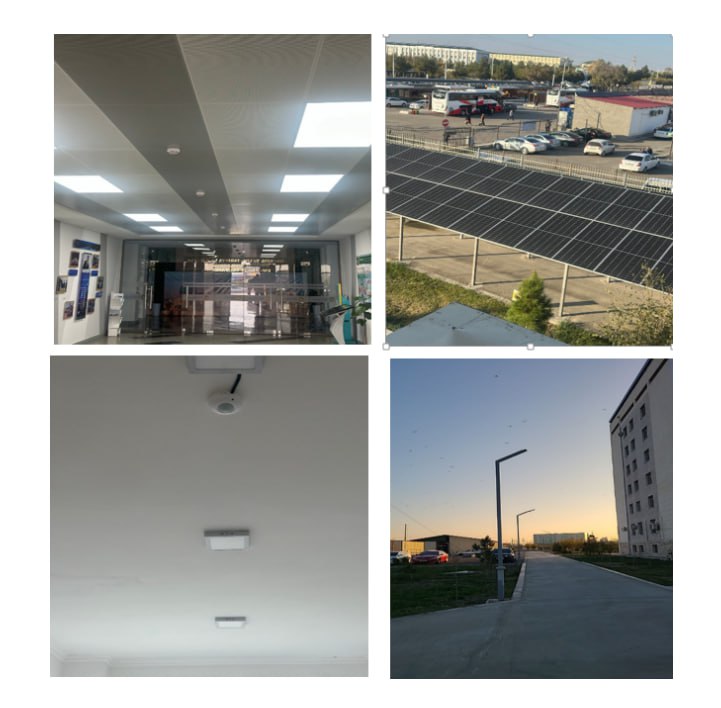
In administrative buildings, energy-intensive incandescent lamps have been fully replaced with modern energy-efficient LED lamps. In order to save electricity resources, around 400 energy-efficient LED lamps and motion sensors were installed in the Institute’s main building, auxiliary facilities, and clinic buildings.
In addition, in order to modernize the lighting systems in the dormitories located on Q. Murtazoyev Street (Dormitory No. 1) and G‘ijduvon Street (Dormitories No. 2, 3, and 4), 270 LED lamps were replaced on the floors. This has significantly reduced electricity consumption in the student dormitories. Furthermore, to increase the efficiency of the lighting system, 130 solar-powered photo sensor LED lights were installed.
7.2.3 Carbon reduction and emission reduction process
7.2.4 Plan to reduce energy consumption
In order to save electricity, modern energy-efficient lighting devices, solar-powered outdoor lighting equipment, and sensor-controlled LED lamps have been installed across the Institute’s facilities. At present, solar panels with a capacity of 200 kW have been installed at the clinic building, 100 kW at the 900-seat academic building, 100 kW at the student dormitory, 50 kW at Dormitory No. 1, 50 kW at the dentistry building, and 20 kW at the academic lyceum building.
During the current year, 200 defective LED lamps were replaced with new ones. The contract is attached. The plan for reducing energy consumption is also attached.
7.2.5 Energy wastage identification
An inspection regarding cases of energy wastage was carried out by the Institute’s audit department. The report is attached.
7.3.1 Indicator: Energy usage per sqm
A plan for reducing energy consumption is available and attached.